
One tap. Every module.
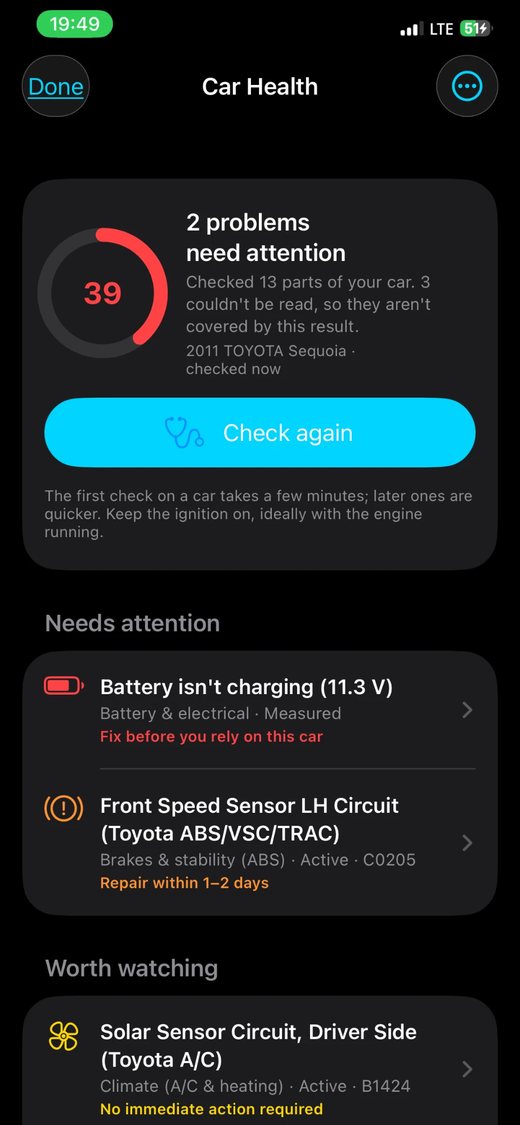
DriveHub's Car Health check reads what your car's computers can tell it, scores your car out of 100 and ranks what needs attention first, in plain language.
How it works
Plug in your adapter
A Bluetooth OBD-II adapter goes into your car's diagnostic port. Keep the ignition on, ideally with the engine running.
Tap Check my car
The first check on a car takes a few minutes. Later ones are quicker.
Read the ranked report
See your score, what needs attention first and what is worth watching.
Every module it can reach
Engine, transmission, brakes and ABS, steering, suspension, airbags, climate, body and electrical: one report instead of one code at a time.
Measured, not just coded
A weak battery or a tired alternator often never sets a code. Car Health measures battery voltage with the engine off and running. Healthy is about 12.6 V off and 13.8 to 14.7 V running.
Ranked by urgency
Findings are ordered so you know what to deal with first, each one explained in plain English with its common causes.
Honest about what it could not read
If a module can't be checked, the report says so instead of showing a false all-clear. In the example on this page, 13 parts were checked and 3 could not be read.
AI repair advice
Ask for an AI explanation of the codes it found, or a full electronics report that reads every module together.
History and trends
Check again next week to see what changed, what came back and whether your battery voltage is slipping. A reminder a week after each check helps catch problems early.
Ready to try it?
DriveHub is free to download on iPhone and Android.
You need a Bluetooth OBD-II adapter, about $15 to $30. DriveHub works with the one you already own.